

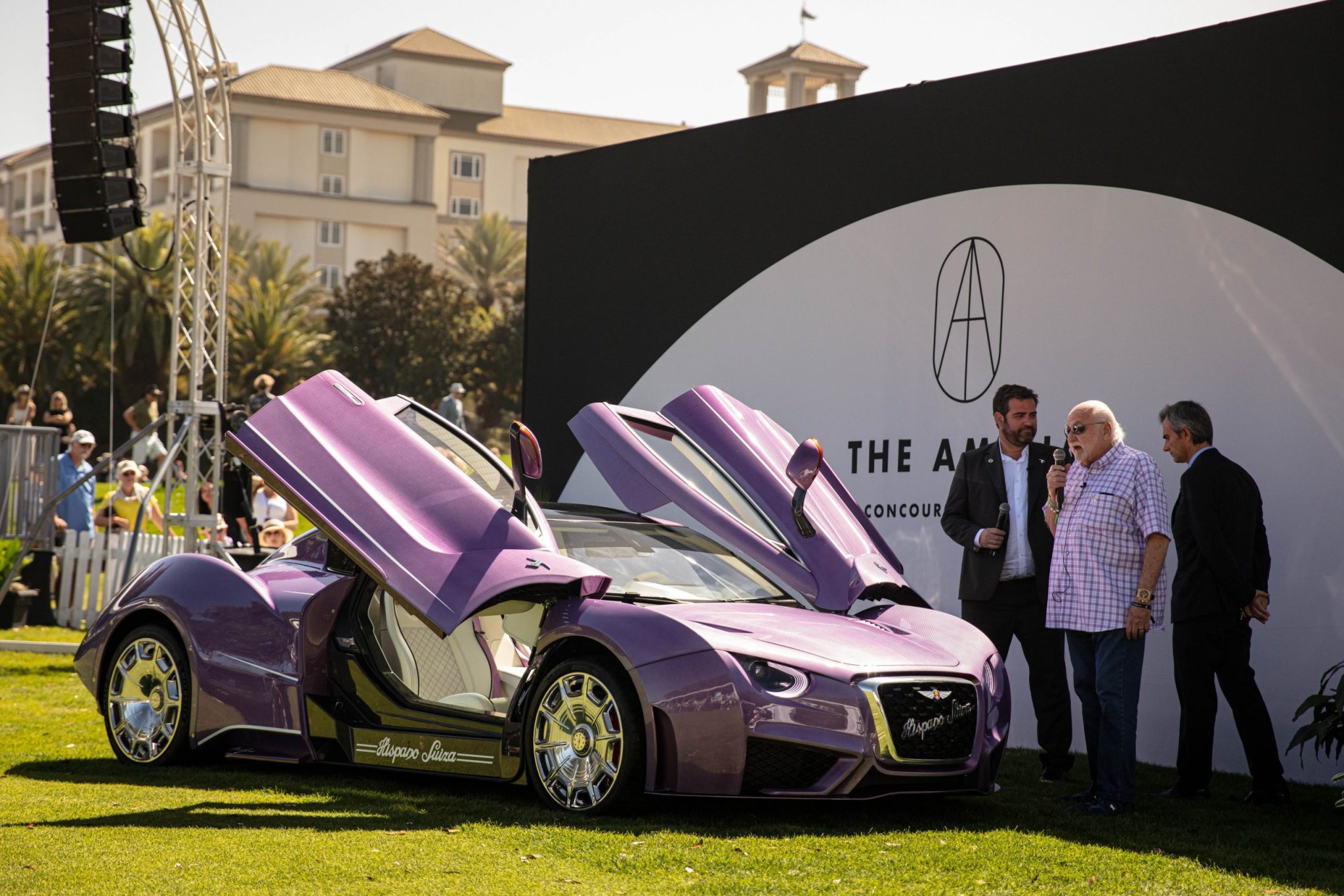
Some cars arrive as transportation, and some arrive as an argument. The Hispano Suiza Carmen Boulogne sits in the second group, because electric hypercar performance is not proven by a wild horsepower number alone. It has to survive questions about weight, traction, battery use, cooling, tires, braking, and whether anyone outside the factory has seen the car move with purpose. For U.S. readers who follow rare EVs through auctions, private sales, Monterey Car Week, or trusted automotive publishing networks, the core answer is clear: the main performance figures are backed by consistent manufacturer data, supplier details, and public running context, but they are still not the same as a full independent instrumented test. Hispano Suiza says the Carmen Boulogne makes 820 kW, or 1,114 PS, reaches 100 km/h in under 2.6 seconds, and tops out at 290 km/h, with QEV Technologies also listing the 80 kWh battery and five-unit plan. The interesting part is not whether the numbers are loud. They are. The interesting part is how much of the story holds up when you read past the headline.
Electric Hypercar Performance Claims That Deserve a Hard Look
A hypercar claim usually starts with a number that feels too neat. In this case, the headline set is 820 kW, 1,114 PS, 0 to 100 km/h in under 2.6 seconds, and a limited 290 km/h top speed. Those figures place the Hispano Suiza Carmen Boulogne in the same conversation as the wildest battery-powered road cars, but the car’s layout makes the claim more unusual. It does not chase all-wheel-drive launch drama. It sends power through the rear axle with four electric motors placed at the back, split across the rear wheels in pairs, according to Goodwood’s description of the related Sagrera system that traces back to the Boulogne.
Why the power claim is the easiest part to believe
Power is the cleanest claim to verify because several sources repeat the same basic figure. Hispano Suiza’s own U.S.-linked press material states 820 kW and 1,114 PS, while QEV Technologies, the engineering partner tied to the Boulogne project, lists the same 820 kW and 1,114 hp figure on its project page. That does not prove every car makes that output in every condition, but it does show the number is not loose forum talk.
The non-obvious part is that horsepower alone is not the magic trick. A heavy luxury EV can make a huge number and still feel dull after two hard pulls. The Boulogne’s better clue is the mix of power and claimed mass. QEV lists a carbon-fiber structure and a 1,630 kg figure, which is light for a battery-powered hypercar with an 80 kWh pack.
Think of it this way. A U.S. buyer comparing a rare electric exotic to a Taycan, Lucid Air Sapphire, or Rimac product may look first at peak output. That is natural. Yet the Carmen Boulogne specs suggest the Spanish car is aiming for a sharper road feel, not only a drag-strip punch.
Why the acceleration number needs more context
The under-2.6-second 0 to 100 km/h claim is believable on paper, but it deserves a footnote in the reader’s mind. Rear-drive electric cars face a harder launch problem than all-wheel-drive cars because the front tires cannot help put power down. The Boulogne answers that with motor control and torque vectoring, rather than extra driven wheels. Salon Privé described the car with a stiff carbon-fiber monocoque, firmer suspension, and torque vectoring tied to the 820 kW powertrain.
That changes the kind of proof you should expect. A launch time from a rear-drive hypercar is more sensitive to tire temperature, road surface, software tuning, and driver setup. A clean runway in warm weather can flatter the car. A cold morning on dusty pavement can make the same claim feel optimistic.
This is where the word “verified” should stay honest. The acceleration claim is supported by repeated official and engineering-source data, plus driving coverage that reports the same figure, but it is not yet the same as a repeatable U.S. magazine test with timing gear. Motor1’s drive coverage listed 0 to 100 km/h in 2.6 seconds, a limited 180.2 mph maximum speed, and 1,100 horsepower in its test summary. That supports the claim’s credibility, while leaving room for real-world variation.
What the Numbers Prove, and What They Leave Open
The Boulogne is not a normal EV with a dramatic body. Its performance story is built around a strange mix: coachbuilt luxury, old-world branding, Formula E-flavored engineering, and a car count so small that public test data will always be thin. That last point matters. When only five units are planned, you do not get the kind of wide owner data that follows a Corvette Z06, Porsche 911 Turbo S, or Tesla Model S Plaid. The sample size is tiny by design.
Which Carmen Boulogne specs are solid enough to trust
The strongest Carmen Boulogne specs are the ones repeated across official, partner, and test-drive sources. The 820 kW output appears across Hispano Suiza and QEV material. The 290 km/h top speed appears in the same places. The 80 kWh battery is also listed by QEV and Motor1, while Motor1 describes a T-shaped lithium-ion battery layout with a range slightly above 250 miles on the NEDC cycle.
Those details line up well enough to treat them as the car’s stated technical base. They also match the broader Carmen family story. Hispano Suiza’s Carmen page describes an 80 kWh, 700 V, liquid-cooled battery layout, with the pack running as a central spine and acting as a tuned mass damper to reduce structural vibration.
The clever part is not the battery size. Plenty of EVs use larger packs. The clever part is packaging it where it can help the chassis feel settled. That matters more in a low-volume hypercar than in a commuter EV, because buyers are paying for sensation, not only range.
What range claims mean for American readers
Range is the claim that U.S. readers should handle with the most care. The Boulogne’s range figures are tied to non-U.S. test context, not an EPA label. Motor1 cited more than 250 miles under NEDC, and QEV describes up to 400 km from the 80 kWh pack. Those numbers are not useless, but they are not equal to an EPA window-sticker number.
The EPA explains that EV range testing blends different driving cycles, including city, highway, higher-speed, hot-weather, and cold-weather tests, and that MPGe also accounts for charging losses. That is why an American collector should not read a European-style range claim as a promise for Los Angeles freeway speeds, Arizona heat, or a cold run across the Hamptons in February. The EPA also notes that weather, accessories, and high-speed driving can reduce EV range.
Here is the counterintuitive part: range may not be the weak point for the Boulogne’s actual owner. A five-unit hypercar is unlikely to be used like a daily commuter. The real concern is repeatable performance during spirited driving, because hard acceleration and track-style use drain energy and raise heat faster than calm highway cruising. For buyers, electric sports car buying guide content should focus less on the largest range number and more on how the car behaves after several hard pulls.
Why the Boulogne Feels Different From Spreadsheet Rivals
A spec sheet can make the Boulogne look like another million-dollar EV trying to win a numbers war. That reading misses the point. Hispano Suiza built this car around identity as much as pace. The Boulogne name points to the brand’s racing history near the French town of Boulogne, and the car uses exposed carbon fiber with copper details to separate it from the standard Carmen’s grander mood.
Why rear-drive changes the whole personality
All-wheel drive is the easy answer for an EV that wants a brutal launch number. The Boulogne’s rear-drive layout makes its claim more daring. It also makes the car more interesting. Instead of masking everything with front-axle traction, the car has to manage power through the rear tires with torque control and chassis tuning.
That means the driver’s trust matters. A car like this cannot feel nervous if it wants to be more than a museum piece. The Motor1 review notes rear-wheel drive, a fixed single-speed transmission, and the 80 kWh pack in its summary, which supports the idea that the car’s personality comes from a focused drivetrain rather than a catch-all layout.
The non-obvious insight is that a slower “paper” launch can sometimes create a better collector car. Not every buyer wants the same clinical hit from every stoplight. Some want a machine that demands judgment. The Boulogne may be faster than most humans can use, yet it still keeps a rear-drive edge that modern EVs often erase.
What public running tells us beyond the brochure
Public appearances matter because they move the car from render to reality. Goodwood reported that the Carmen made a dynamic debut at the Festival of Speed in 2022, the Carmen Boulogne appeared there in 2023, and the Sagrera followed in 2024. That does not equal a full road test, but it helps answer a basic question: did these cars operate in front of crowds, under event pressure, and outside a studio?
That is not a small detail. Rare EV makers can make beautiful claims while never giving the public more than a static display. The Boulogne has at least been part of a visible running story. For a buyer or reader in the U.S., that matters when separating a true small-series car from a vapor project.
Still, the standard should stay fair. A hillclimb appearance does not verify top speed. A private drive does not prove durability across years of ownership. The best reading is balanced: the electric hypercar claims are credible enough to take seriously, but not broad enough to remove all doubt.
What U.S. Buyers Should Check Before Trusting the Story
The American market sees rare European cars through a different lens. Import rules, service access, charging support, parts lead times, software control, insurance, and resale all affect the ownership story. The first Carmen Boulogne unit to arrive in the U.S. appeared at the New York City Concours, where Hispano Suiza highlighted the same 820 kW, 290 km/h, and under-2.6-second acceleration figures. That gives U.S. readers a local hook, but not a full ownership answer.
Why service access matters more than the top speed
A 180 mph limited top speed sounds exciting. In the U.S., it is also close to irrelevant unless the car sees private runway events or track use. Service access matters far more. A collector in Miami, Austin, Los Angeles, or Greenwich needs to know who can inspect the high-voltage system, update software, source body panels, and handle battery issues without turning the car into a six-month paperweight.
This is where tiny production can cut both ways. Five units make the car more special, but they also limit the support network. QEV’s involvement helps the engineering story because it ties the project to electric motorsport and EV development, but owners still need clear service pathways in their region.
The quiet truth is that some hypercars are bought for ownership ease, while others are bought because difficulty is part of the club. The Boulogne belongs to the second camp. That does not make it flawed. It means a smart buyer should treat rare hypercar ownership costs as part of the performance review.
How to read the verified claims before purchase
A careful buyer should separate three layers. First are manufacturer and engineering claims: power, battery size, top speed, acceleration, and production count. Second are observed claims: public running, press drives, and event appearances. Third are owner claims: charging behavior, reliability, software support, and resale demand. The Boulogne has stronger proof in the first two layers than in the third, mainly because so few cars exist.
That is normal for this kind of machine. No one should expect Camry-level owner data from a five-unit Spanish hypercar. The smarter question is whether the car’s claims fit together. In the Boulogne’s case, they mostly do. Low mass for an EV, a high-output rear motor setup, a carbon monocoque, torque control, and public running all support the broad story.
One more point matters for American readers: federal range language and European-style range language do not speak the same dialect. The EPA’s EV range testing explanation is useful because it shows how much testing method shapes the number printed beside an electric car. Once you understand that, the Boulogne’s range claim becomes easier to place. It is a guide, not a guarantee.
Conclusion
The Carmen Boulogne is not easy to judge because it lives between proof and theater. The hard figures are not empty. They come from official brand material, engineering partner data, and drive coverage that lines up around the same power, acceleration, battery, and speed numbers. That is enough to say the headline claims are credible, not random hype. The lasting lesson from electric hypercar performance is that numbers matter most when the hardware story makes sense. Here, the carbon structure, rear-mounted motor layout, torque control, and limited production plan all point in the same direction. Still, a cautious reader should not confuse verified claims with full independent certification under every condition. The Boulogne’s promise is narrower and more personal than that. It is a rare, road-focused Spanish EV built for collectors who want drama, risk, and craft in the same garage space. Before trusting the dream, check the proof. Then decide whether the dream is worth owning.
Frequently Asked Questions
How fast is the Hispano Suiza Carmen Boulogne from 0 to 100 km/h?
The claimed time is under 2.6 seconds. That figure is supported by Hispano Suiza material, QEV Technologies data, and press-drive coverage, but public independent timing from a major U.S. test outlet remains limited because production is so small.
What is the top speed of the Carmen Boulogne?
The stated top speed is 290 km/h, or about 180 mph. It is described as limited, which means the car may be electronically capped rather than running to its full possible speed under ideal gearing and power conditions.
Is the Carmen Boulogne sold in the United States?
At least one Carmen Boulogne reached the U.S. and appeared at the New York City Concours. Availability is not like a normal dealership model because only five units were planned, and each car is tied to a high-end custom process.
How much power does the Hispano Suiza Carmen Boulogne make?
The car is listed at 820 kW, equal to 1,114 PS. Some coverage rounds the output to about 1,100 horsepower, which is common when converting between metric horsepower, mechanical horsepower, and simplified reader-facing figures.
What battery does the Carmen Boulogne use?
The Boulogne is tied to an 80 kWh battery pack. Related Carmen family material describes a T-shaped, liquid-cooled battery layout, which helps packaging and may aid chassis balance by placing mass through the center of the car.
Is the Carmen Boulogne faster than a Tesla Model S Plaid?
In a simple launch comparison, the answer is not certain without same-day instrumented testing. The Tesla has all-wheel-drive traction and mass production data. The Boulogne has lower claimed weight, huge output, and a rarer rear-drive setup.
Are the electric hypercar claims fully proven?
They are credible but not fully proven in the way a widely tested production car is proven. The main figures appear across official, partner, and media sources, while broader durability and repeatability data remain limited due to tiny production.
Is the Carmen Boulogne worth following as a collector car?
Yes, especially for readers who care about rare EV history. Its value story is tied to five-unit production, Hispano Suiza heritage, Barcelona-built engineering, and a design that feels separate from the more common speed-first hypercar formula.